

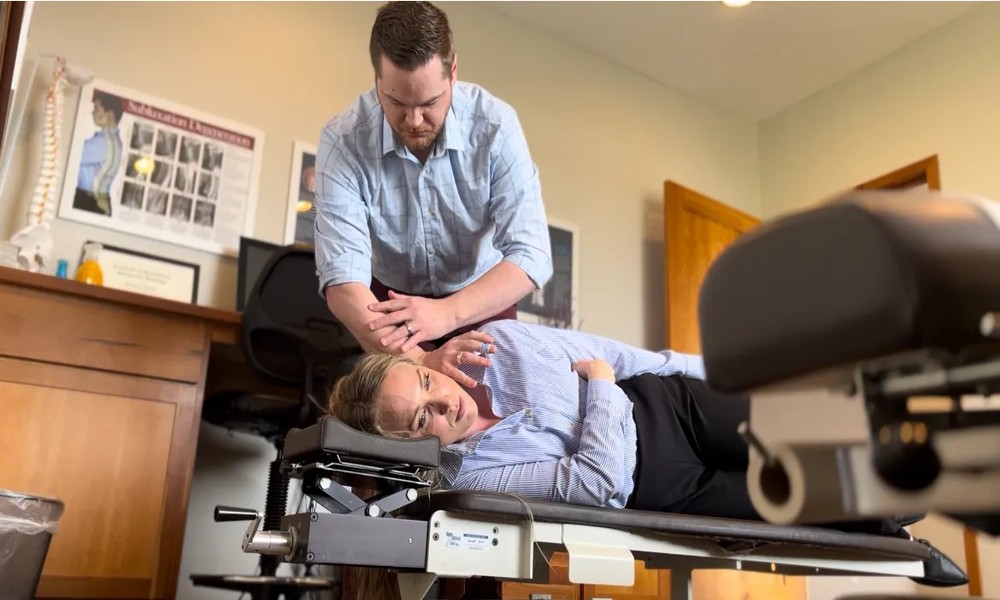
Most people who walk into a chiropractor’s office for the first time are bracing for the same thing: a quick twist, a loud pop, and a stranger’s hands on their neck. That image keeps a lot of people from seeking care for headaches, vertigo, and chronic neck pain that chiropractic could actually help. NUCCA is a different approach, and it is the technique Draper Spinal Care has built its practice around. There is no twisting, no cracking, no forceful manipulation of the cervical spine. What there is, instead, is precise measurement and a small, deliberate correction at the top of the neck that lets the rest of the body rebalance itself.
NUCCA stands for the National Upper Cervical Chiropractic Association, a group of chiropractors trained in a specific protocol developed by Dr. Ralph Gregory in the 1960s. The technique has been refined for more than half a century and is taught with strict standards.
Why People Are Afraid of Traditional Chiropractic
The fear is not irrational. A high-velocity, low-amplitude adjustment is a real procedure, and it works for many patients, but it also looks and sounds dramatic. Some people have read about rare complications involving the vertebral artery. Others have been to a chiropractor who moved too fast, did not take imaging, or used the same maneuver on every patient regardless of the underlying issue. If that has been your experience, an alternative that does not involve any of those elements is worth knowing about.
How a NUCCA Correction Actually Works
The atlas, or C1, is the top vertebra of the spine. It is shaped like a ring, sits just below the skull, and holds up an average ten to twelve pound human head. When the atlas shifts even a fraction of a degree off its proper alignment, the head tilts, and the rest of the spine compensates. Shoulders rotate. The pelvis levels out unevenly. One leg appears shorter than the other when lying down. The muscles on one side of the neck stay chronically tighter than the other. Over months and years, that compensation pattern is what produces a lot of the pain people show up with.
A NUCCA correction is a light, controlled contact applied behind the ear with the patient lying on their side. There is no twisting of the neck, no rapid movement, no audible pop. The chiropractor uses body mechanics to deliver a specific vector calculated from the patient’s own X-rays. Most patients describe the sensation as a gentle press that lasts a second or two.
The X-Ray Protocol That Makes It Precise
Every NUCCA patient receives a three-view set of upper cervical X-rays before the first correction. The images are analyzed to measure the exact angle and direction of the atlas misalignment in three dimensions. Those measurements determine the vector of the correction down to fractions of a degree. After the adjustment, post-X-rays confirm that the correction actually changed the alignment in the way the analysis predicted. A NUCCA chiropractor cannot guess at the angle and cannot adjust the same way for two different patients. The measurement is the technique.
Why One Vertebra at the Top Affects the Whole Body
The reason a small correction at C1 can produce body-wide changes has to do with how the spine compensates. Imagine a building with a slightly tilted foundation. Every floor above it has to shift to keep the structure upright. The roof might end up only a half inch out of plumb, but the walls and floors between are bearing the strain. The body does the same thing. Correct the foundation at the atlas, and the structures above and below begin to unwind their compensations.
This is why NUCCA patients often notice changes in places they did not expect. Lower back pain can ease after an upper cervical correction. So can hip alignment, jaw position, and balance. The body is a connected system, and the atlas sits at one of its most influential points.
Conditions That Tend to Respond
NUCCA care is most commonly sought by people dealing with:
- Chronic migraines and tension headaches that have not responded to medication
- Post-concussion symptoms and lingering effects of whiplash
- Vertigo, dizziness, and Meniere-like symptoms
- Chronic neck pain, especially when imaging does not show a clear cause
- TMJ dysfunction and jaw pain
- Sciatica and lower back pain rooted in postural compensation
The technique does not treat conditions directly. It removes interference at the cranio-cervical junction so the nervous system and musculoskeletal system can function without the chronic compensation pattern. Many patients see results gradually as their body holds the correction longer between visits.
What a First Visit at Draper Spinal Care Looks Like
The initial appointment with Dr. Joshua Stockwell at Draper Spinal Care includes a consultation, a postural and neurological examination, and the three-view atlas X-ray series if you are a candidate for care. The first correction usually happens on a separate visit once the analysis is complete. From there, the care plan is built around how well your body holds the correction. Some patients hold for weeks. Some hold for months. The goal is to extend the time between corrections, not to schedule indefinite weekly visits.
Considering NUCCA Care in Draper
If the idea of being adjusted has kept you away from chiropractic, NUCCA is worth a closer look. The technique was designed for patients who want a measured, gentle alternative to traditional manipulation, and Draper Spinal Care has built its practice around delivering it well. Schedule a free consultation to find out whether you are a candidate. The conversation costs nothing, and it may be the first time someone has actually shown you what is going on at the top of your spine.
